Regain your strong, luscious hair
Hair Loss
Alopecia—the medical term for hair loss—is a common condition in both men and women. Contrary to popular belief, androgenetic alopecia (AGA), or patterned baldness, also affects women. The only difference is that in women, it is called female pattern hair loss (FPHL). It’s a common condition, affecting roughly 50% of women in their lifetimes.
Get StartedWhy does hair matter?
The appearance of your hair reflects your overall health. Maintaining healthy hair often requires a balanced lifestyle, including proper diet, regular exercise, and good hair care practices, which in turn promote overall well-being.
- Nutritional status: Healthy hair often reflects good overall health and nutrition. Hair loss or brittle hair can be a sign of nutritional deficiencies and underlying health issues.
- Psychological well-being: Women with thick, healthy hair often feel more confident and satisfied with their appearance, positively impacting their self-esteem.
- Social interactions: In many cultures and professional settings, healthy and well-groomed hair contributes to a positive first impression.

Our approach to hair regrowth
Our approach to hair restoration is evidence-based. Opt Health combines the latest medical research with cutting-edge solutions to target the root causes of hair loss. Our goal is to help you achieve optimal hair regrowth and increased confidence.
Increase hair growth
Substances like minoxidil and melatonin extend the growth phase of the hair cycle.
Improve scalp health
Vitamin E, caffeine, and menthol nourish the scalp, creating an optimal environment for hair growth.
Reduce breakage
Ascorbic acid, panthenol, and sodium hyaluronate decrease hair shedding.
Block DHT
DHT, a derivative of testosterone, binds to hair follicle receptors, causing them to shrink and eventually stop producing hair. High levels of DHT but low levels of estrogen, such as in menopause, might contribute to DHT-mediated hair loss.
Increase hair growth
Substances like minoxidil and melatonin extend the growth phase of the hair cycle.
Improve scalp health
Vitamin E, caffeine, and menthol nourish the scalp, creating an optimal environment for hair growth.
Reduce breakage
Ascorbic acid, panthenol, and sodium hyaluronate decrease hair shedding.
Block DHT
DHT, a derivative of testosterone, binds to hair follicle receptors, causing them to shrink and eventually stop producing hair. High levels of DHT but low levels of estrogen, such as in menopause, might contribute to DHT-mediated hair loss.
Does your hair need a little boost?
Opt Health’s personalized approach to hair loss empowers women to feel comfortable and confident at any stage of life. Unlike traditional treatments, our approach takes a closer look at your lifestyle habits, health status, and hair care methods.
- Hormonal changes such as during pregnancy or menopause
- Unhealthy health conditions
- Unhealthy lifestyle habits
More than radiant skin
Our expert team specializes in longevity and functional medicine for men and women. We address a wide range of issues affecting women’s health and quality of life, including bone and sexual health, hormone replacement therapy, and more.
Female pattern hair loss presentation
Female pattern hair loss, or FPHL, usually appears as diffuse thinning across the crown with a part that becomes wider. FPHL differs from the male pattern, which more often begins with a receding hairline. Because thinning is spread across the crown, the change is harder to spot than a clear recession at the front.
Women are often told that diffuse thinning is normal shedding. Calling diffuse crown thinning normal shedding can delay the distinction between a temporary shedding episode and androgenetic alopecia. FPHL is androgenetic alopecia in women. Roughly 50% of women experience FPHL during their lifetimes. A prevalence estimate cannot identify the cause of an individual case.
The location of the hair loss gives your physician a useful starting point. Crown thinning and a widening part fit the female pattern, while a receding hairline fits the male pattern. Recent illness, surgery, childbirth, significant weight loss, iron deficiency, thyroid disease, and the menopause transition belong in a separate cause review. A separate cause review prevents a familiar-looking pattern from being treated without checking another explanation. Ask your physician to identify the pattern and assess other causes before choosing a hair treatment.
The causes worth ruling out first
Your physician needs to rule out temporary shedding, iron deficiency, thyroid disease, and menopause-related hormone change before selecting a pattern-loss treatment. Telogen effluvium sometimes follows illness, surgery, childbirth, or significant weight loss. Telogen effluvium is self-limiting and needs no hair treatment. When a recent trigger explains diffuse shedding, a pattern-loss protocol addresses the wrong diagnosis.
Iron deficiency is another cause to assess. Heavy periods make iron deficiency common, and ferritin reveals the deficiency before hemoglobin changes. Your physician interprets ferritin and hemoglobin in the context of menstrual history rather than treating the hair change in isolation. Thyroid disease also belongs in the clinical evaluation because thyroid disease can produce hair loss.
During the menopause transition, falling estrogen shifts the androgen balance. Your physician considers the hormonal shift alongside the distribution of thinning instead of assuming FPHL from age or life stage alone.
Telogen effluvium, iron deficiency, thyroid disease, and menopause-related hormone change require different responses. Telogen effluvium resolves without hair treatment, while iron deficiency and thyroid disease need evaluation directed at the underlying condition. Treating pattern loss before completing the cause review treats the wrong thing. Your physician should review recent illness, surgery, childbirth, weight loss, menstrual bleeding, thyroid disease, and the menopause transition before deciding whether a hair-loss protocol fits the diagnosis.
The protocol's hair cycle and scalp targets
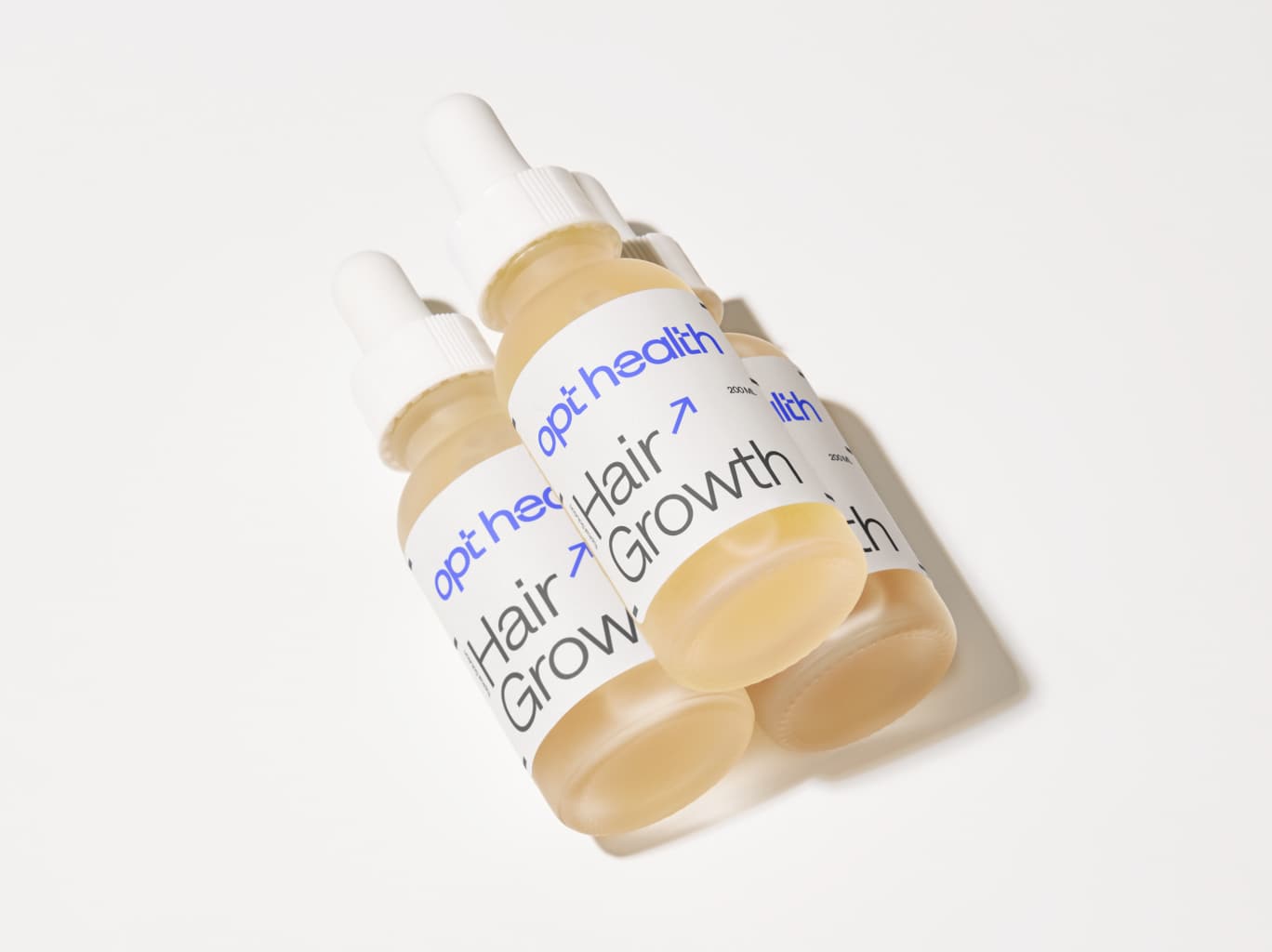
The protocol targets the growth phase of the hair cycle and the scalp environment around growing hair. Minoxidil and melatonin extend the growth phase. Vitamin E, caffeine, and menthol support the scalp environment. Growth-phase extension and scalp support serve separate purposes within the protocol. The defined functions give your physician a concrete basis for explaining why each ingredient appears in a treatment plan.
Hair regrowth treatments work on hair that remains capable of growing. Timing matters because a regrowth treatment needs growth-capable hair as its target. Scalp support does not create a promise of regrowth, and neither target establishes a particular timeline. Your physician therefore considers the diagnosis and the remaining growth capacity before deciding whether the protocol fits.
Your physician confirms FPHL before discussing ingredients because telogen effluvium, iron deficiency, thyroid disease, and menopause-related hormone change require different responses. If iron deficiency explains the hair loss, scalp support does not address the deficiency. If thyroid disease explains the hair loss, growth-phase treatment does not address the thyroid disease.
Once your physician identifies FPHL, the next conversation can focus on whether growth-phase treatment and scalp support belong in your plan. Your prescriber then sets the treatment plan after reviewing the diagnosis, existing conditions, and current medications.
The Opt Take on hair loss in women
Our view is that hair loss deserves a diagnosis before treatment begins. Diffuse crown thinning can reflect FPHL, telogen effluvium, iron deficiency, thyroid disease, or hormone changes during menopause. The cause determines the clinical response.
Opt Health's women's track supports women through perimenopause, menopause, and post-menopause. Care begins with an in-home blood test or a visit to a local partner lab for 55+ biomarkers. An Opt Health physician then reviews the results with you in a 1:1 consultation and sets a plan. Existing conditions and current medications are part of the initial review. If hair loss is part of your concern, raise hair loss during an Opt Health consultation so your Opt Health physician can assess the pattern and possible causes.
Get started: Begin with Opt Health, where a physician reads your labs, builds your plan, and adjusts it over the loop.
FAQ’s
Hair loss questions
Postpartum shedding is telogen effluvium triggered by the sharp drop in estrogen after childbirth, making it a temporary, self-limiting event that needs no hair treatment. Shedding during perimenopause or menopause occurs when falling estrogen shifts the androgen balance, which can cause diffuse shedding or unmask female pattern hair loss. Your physician evaluates the distribution of thinning alongside these hormonal shifts to confirm the diagnosis before selecting a treatment approach.