Back
Keto Diet for Men Built Around Protein and Training
By GetOPT Review Team · September 25, 2026
·Part of our Weight Loss Guide
A keto diet for men uses the same carbohydrate limits as any ketogenic diet: usually under 50 grams per day and sometimes as low as 20 grams.1 Your calorie intake, protein share, training plan, and hormone data determine whether keto fits your goals. The evidence on keto and lean mass is mixed, so your protein, calories and training need watching. Baseline and follow-up labs show how your testosterone, insulin, and cholesterol respond.
Carbohydrate, Protein, and Calorie Targets for a Keto Diet for Men
A ketogenic diet restricts carbohydrates until the body begins producing ketones from fat. The Harvard T.H. Chan School of Public Health describes carbohydrate intake below 50 grams per day, with some plans going as low as 20 grams.1
Harvard reports that popular keto plans often provide 5% to 10% of calories from carbohydrates, 10% to 20% from protein, and 70% to 80% from fat. These percentages describe a general ketogenic diet. They do not set your individual intake.1
Your calorie target should reflect your body size, activity, and goal. A calorie deficit may support weight loss, while muscle gain usually requires enough energy to support training. Use the macro calculator and select the keto setting to estimate your own calorie, carbohydrate, protein, and fat numbers.
Protein requires more care than simply choosing the highest possible number. Harvard describes keto protein as moderate because some amino acids can be converted into glucose, which may interfere with ketosis.1 Your physician can help balance ketosis, lean-mass retention, training demands, and your lab results.
Training and Lean Mass During Keto
The evidence on keto and muscle retention is mixed. Your training history, calorie intake, and protein intake can change the outcome.
Wilson et al. studied 25 college-aged, resistance-trained men. Strength and power increased to a similar extent with keto and a Western diet, but the trial included only 10 weeks of keto followed by one week of carbohydrate reintroduction.2 The small and young study population limits how far you can apply the findings.
Ashtary-Larky et al. pooled 13 randomized trials with 244 participants. Keto reduced body mass and fat mass, but it also reduced fat-free mass by an average of 1.26 kilograms compared with non-keto diets.3 Resistance training did not remove that difference.
Vargas-Molina et al. analyzed five studies with 111 trained participants, including 87 men. The analysis found no clear difference in fat-free mass between keto and control diets. The authors concluded that muscle gain on keto required an energy surplus.4
If you train, keep resistance exercise in the plan and monitor your performance. The benefits of strength training extend beyond muscle size. If your strength or lean mass declines, your physician can review your calorie deficit, protein target, and recovery before the loss progresses.
Keto and Testosterone Levels
Keto does not have one predictable effect on testosterone. The available studies differ in calorie intake, protein share, training status, age, and weight loss.
Whittaker and Harris reviewed 27 studies involving 309 healthy adult men eating diets with 35% of calories or less from carbohydrates. Moderate-protein diets, defined as less than 35% of calories from protein, had no consistent effect on resting total testosterone. Low-carbohydrate diets with 35% or more of calories from protein lowered resting total testosterone in that analysis.5
Furini et al. reviewed seven studies with 230 participants. Total testosterone rose across the included ketogenic diets, but the increase was greater with very-low-calorie diets and depended on age and weight loss. Only three studies enrolled men with overweight or obesity, and the biological mechanism remained unclear.6
The Wilson trial also reported higher testosterone in the keto group, but the final measurement came after carbohydrates were reintroduced. That trial does not establish that ketosis alone raised testosterone.2
A baseline and follow-up testosterone blood test can show how your own levels respond. If your labs or symptoms point toward low testosterone, your physician can review the full pattern before changing your diet or considering treatment.
Keto for Men Over 50
Men over 50 have limited age-specific keto data. The available older-adult trial included both men and women, while the protein guidance for older adults begins at age 65.
Goss et al. studied 34 adults aged 60 to 75 with obesity for eight weeks. The very-low-carbohydrate group lost more total and visceral fat than the low-fat group. Thigh skeletal muscle was greater after adjustment for fat loss, but the trial did not measure strength or long-term sarcopenia outcomes.7
Sarcopenia is the age-related loss of muscle mass and function. The PROT-AGE Study Group recommends 1.0 to 1.2 grams of protein per kilogram of body weight per day for people over 65. It recommends 1.2 grams per kilogram or more for active older adults and 1.2 to 1.5 grams for most older adults with acute or chronic disease.8
Those figures are consensus guidance for older adults. They are not keto-specific targets. People with severe kidney disease and an estimated glomerular filtration rate below 30 mL/min/1.73 m² may need to limit protein, so a physician should set the target.8
A Sample Keto Day
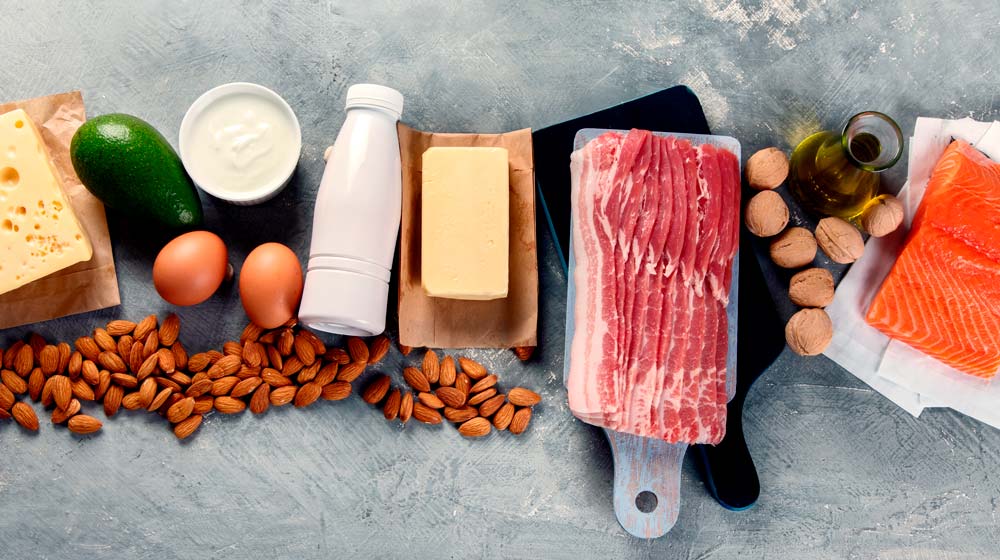
A sample keto day can stay simple. Breakfast could include eggs and vegetables prepared with olive oil. Lunch could include fish with vegetables and olive oil, followed by meat and vegetables at dinner.
Portions depend on your calorie and protein targets. The full seven-day keto meal plan provides more structure without turning one example into a standard menu for every man. Use the net-carb counts for common keto foods when planning what to buy.
Lab Markers Before and During Keto
Baseline labs give you a reference point for testosterone, fasting insulin, and blood lipids. Follow-up testing shows whether the diet is moving those markers in a direction your physician wants to continue.
Bueno et al. pooled 13 randomized trials with at least 12 months of follow-up. Very-low-carbohydrate ketogenic diets produced 0.91 kilograms more weight loss than low-fat diets, but low-density lipoprotein cholesterol was 0.12 mmol/L higher on average.9 The trials included men and women, so the result was not specific to men.
A lipid panel should be read as a pattern. Low-density lipoprotein cholesterol, high-density lipoprotein cholesterol, and triglycerides can move in different directions during keto.9 A physician can interpret those changes alongside fasting insulin, body composition, and your medical history. For a focused review of cholesterol and other concerns, see keto side effects.
The Opt Take on Keto for Men
A keto diet should be adjusted from your results over time. At Opt Health, a physician reviews 55+ biomarkers against your symptoms, training, and goals before building your plan.
Follow-up labs and physician consultations repeat every three to four months. That loop shows whether your plan is supporting body composition while keeping testosterone, insulin, and cholesterol in view. If you are considering a keto diet for men, bring your training goal, current diet, and baseline labs into the decision.
Get started: Begin with Opt Health, where a physician reads your labs, builds your plan, and adjusts it over the loop.
Frequently Asked Questions
The keto diet for men is a high-fat, moderate-protein, very-low-carbohydrate diet. Harvard describes carbohydrate intake below 50 grams per day and sometimes as low as 20 grams.1 Men follow the same basic diet, but calories, protein, training, and hormone monitoring should reflect individual goals.
Low-carbohydrate diets, including keto, showed no consistent effect on testosterone when protein stayed below 35% of calories. A meta-analysis found no consistent effect with protein below 35% of calories, while low-carbohydrate diets with 35% or more protein lowered resting total testosterone.5 Testosterone increases reported in another review were tied partly to age and weight loss.6
You may be able to build muscle on keto, but the evidence is mixed. One review found no clear fat-free-mass difference, while another found lower fat-free mass with keto.3,4 Muscle gain also requires enough calories to support training, so keto should not be treated as a muscle-gain guarantee. Track your strength and body composition, and your physician can adjust calories and protein if either slips.
Harvard describes protein as 10% to 20% of calories in popular keto plans.1 PROT-AGE recommends 1.0 to 1.2 grams per kilogram per day for people over 65, with higher figures for active older adults.8 Use the macro calculator and have your physician set the final target.
Keto may fit some men over 50, but the age-specific evidence is limited. An eight-week trial in adults aged 60 to 75 found greater fat loss with a very-low-carbohydrate diet, but it included men and women and did not measure strength or sarcopenia outcomes.7 A physician can set your protein target and track your strength and labs as you go.
The research does not set a reliable pounds-per-week figure for men, so your own trend is the number to track. Across 13 long-term trials involving men and women, keto produced 0.91 kilograms more weight loss than low-fat diets.9 Harvard reports that weight-loss effects after one year are similar to conventional diets.1
The way to know whether keto is working for you is to measure it. An Opt Health membership pairs 55+ biomarkers with a one-on-one physician consultation and repeat testing every 3 to 4 months, so your plan is adjusted on what your testosterone, insulin and lipids actually did.
References
- Harvard T.H. Chan School of Public Health. Diet review: ketogenic diet for weight loss. The Nutrition Source. Accessed September 25, 2026. https://nutritionsource.hsph.harvard.edu/healthy-weight/diet-reviews/ketogenic-diet/
- Wilson JM, et al. Effects of ketogenic dieting on body composition, strength, power, and hormonal profiles in resistance training men. J Strength Cond Res. 2020;34(12):3463-3474. https://pubmed.ncbi.nlm.nih.gov/28399015/
- Ashtary-Larky D, et al. Effects of resistance training combined with a ketogenic diet on body composition: a systematic review and meta-analysis. Crit Rev Food Sci Nutr. 2022;62(21):5717-5732. https://pubmed.ncbi.nlm.nih.gov/33624538/
- Vargas-Molina S, et al. Effects of the ketogenic diet on muscle hypertrophy in resistance-trained men and women: a systematic review and meta-analysis. Int J Environ Res Public Health. 2022;19(19):12629. https://pubmed.ncbi.nlm.nih.gov/36231929/
- Whittaker J, Harris M. Low-carbohydrate diets and men's cortisol and testosterone: systematic review and meta-analysis. Nutr Health. 2022;28(4):543-554. https://pubmed.ncbi.nlm.nih.gov/35254136/
- Furini C, et al. Ketogenic state improves testosterone serum levels-results from a systematic review and meta-analysis. Endocrine. 2023;79(2):273-282. https://pubmed.ncbi.nlm.nih.gov/36149528/
- Goss AM, et al. Effects of weight loss during a very low carbohydrate diet on specific adipose tissue depots and insulin sensitivity in older adults with obesity: a randomized clinical trial. Nutr Metab (Lond). 2020;17:64. https://pubmed.ncbi.nlm.nih.gov/32817749/
- Bauer J, et al. Evidence-based recommendations for optimal dietary protein intake in older people: a position paper from the PROT-AGE Study Group. J Am Med Dir Assoc. 2013;14(8):542-559. https://pubmed.ncbi.nlm.nih.gov/23867520/
- Bueno NB, et al. Very-low-carbohydrate ketogenic diet v. low-fat diet for long-term weight loss: a meta-analysis of randomised controlled trials. Br J Nutr. 2013;110(7):1178-1187. https://pubmed.ncbi.nlm.nih.gov/23651522/
This content is for informational purposes and does not replace evaluation, diagnosis, or treatment by a qualified medical professional.
This article is part of our guide to weight loss. See the doctor-guided weight loss program at Opt Health.



Start Today
Your health, your terms. Discover how personalized care can transform not just the way you feel, but how you live.