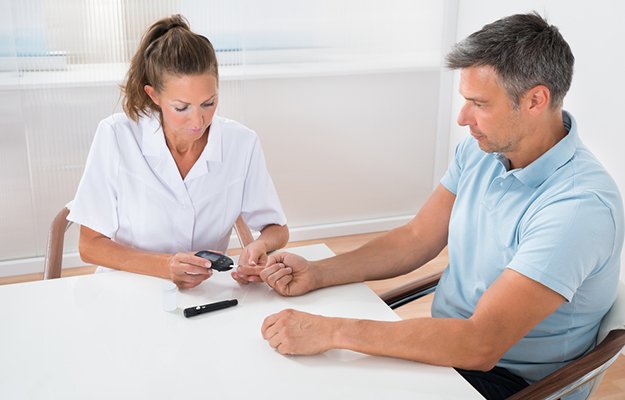
Deciding you want your testosterone measured is the easy part. The next question has four answers, and they differ in price, in what gets measured, and in whether anyone qualified reads the result. Our page on the signs you need a testosterone test covers whether to test at all.
Subscribe for more
Join our newsletter to get the latest news, tips, and stories from Opt Health.
The four routes compared
| At-home kit | Walk-in lab (Labcorp or Quest) | Telehealth clinic panel | Your primary care physician | |
|---|---|---|---|---|
| How you order it | Online, no prescriber contact | Online direct-to-consumer, or a physician's order | Included when you join | At an appointment |
| Sample | Finger-prick or saliva, collected by you | Venous draw by a phlebotomist | Venous draw, usually at a partner lab near you | Venous draw |
| What is typically measured | Total testosterone, sometimes free. Small panels | Whatever you order, from a single marker to a full panel | A defined panel set by the clinic, typically covering hormones plus metabolic and blood-count markers | Usually total testosterone, plus whatever else is clinically indicated |
| Turnaround | Days, plus shipping in both directions | Typically 1 to 3 business days | Days, then a review appointment | Days, then a follow-up appointment |
| Who interprets it | Nobody, unless you pay for a consult | Nobody, on the direct-to-consumer path | A physician, as part of the service | Your physician |
| Can it lead to a prescription | No | No, on its own | Yes, if clinically appropriate | Yes |
| Relative cost | Low | Low for a single marker, moderate for a panel | Highest, and it includes the physician | Depends on your insurance and deductible |
| Insurance | No, though it may be HSA or FSA eligible | Usually not on the direct-to-consumer path | Usually cash-pay | Usually billable |
At-home kits
These are the cheapest and least useful route for the question most men are actually asking. The convenience is real: no appointment, no phlebotomist, a result in your inbox. The limits are structural rather than a matter of picking a better brand.
Sample type is the first one. Kits that use saliva are measuring something that correlates imperfectly with the serum concentration clinicians use to make decisions. The diagnostic guidelines are written around serum total testosterone, and salivary assays are not the basis for them.1,2 Kits that use a finger-prick collect capillary blood, which is closer to a venous draw. It brings its own variability in how much sample you manage to collect and how long it sits before it ships.
The second limit is that a single testosterone value is not a diagnosis. Both the Endocrine Society and the American Urological Association call for the diagnosis to rest on two separate early-morning measurements, because testosterone varies substantially day to day and within a single day.2,3 A one-off number from a kit cannot meet that standard, whatever it says.
The third is that nobody reads it. You receive a figure and a reference range, and reference ranges differ between laboratories and assays.
Practical takeaway: an at-home kit is reasonable as a first look if you are undecided about whether to pursue this at all. It is not a substitute for a serum draw if you intend to act on the result.
Walk-in labs: Labcorp and Quest
Labcorp and Quest Diagnostics are the two largest independent clinical laboratory networks in the United States, and both now sell tests directly to consumers as well as processing physician orders. You order online, you go to a patient service centre, a phlebotomist draws blood, and the result appears in a portal.
Labcorp and Quest differ on location and convenience. The science is the same. Both are accredited high-complexity laboratories running validated assays. The practical differences are which one has a collection site near you, which one your physician's system already interfaces with, and what each charges for the specific panel you want. Prices for the same marker differ between the two and change, so compare the exact panel rather than the brand.
One technical point does matter when comparing results. Immunoassay and mass spectrometry are different measurement methods, and mass spectrometry is the more accurate approach, particularly at the low end of the range and for free testosterone.4 If you are comparing a result to an earlier one, comparing across laboratories or across methods introduces a difference that is not a change in you.
Direct-to-consumer ordering is not available everywhere. Some states still restrict consumer-initiated laboratory testing, and the rules have been changing. Both companies publish the current state list on their own consumer-testing pages, so check yours before you pay.
A telehealth clinic's included panel
Hormone-focused telehealth clinics, Opt Health included, bundle the draw into the service. You join, a physician orders a panel, you have blood drawn at a partner collection site, and a clinician reviews the results with you. This is the most expensive route per test and the only one that arrives with interpretation attached.
You are paying for the interpretation. A testosterone number in isolation answers very little, because the same value means different things depending on SHBG, LH, oestradiol, thyroid function, and metabolic markers around it. Our biomarker guide covers what a full panel contains and why the pattern across markers is more informative than any single one.
This route costs more than the other three. If your only goal is to see a number, it is the wrong choice. It becomes the right one when you intend to do something about the answer. Our TRT cost breakdown covers where the money goes.
Your primary care physician
This is often the cheapest route if you have insurance. Your physician can order a testosterone panel, it is generally billable when clinically indicated, and the result lands in a record that follows you.
Two frustrations are common enough to name. Some primary care physicians will order total testosterone and nothing else, which leaves you unable to tell a genuinely low value from a high-SHBG picture. And a result inside a wide laboratory reference range is often reported back as normal with no further discussion. That experience is what sends most men looking for a second opinion. Both are addressable by asking for the specific markers before the draw rather than after it.
How to prepare for the draw
Preparation changes the result more than which laboratory you use. The guidelines are specific about it because the measurement is being used to make a diagnosis.
- Go in the morning. Both the Endocrine Society and the AUA specify early-morning measurement, because testosterone follows a daily rhythm and afternoon values run lower.2,3
- Expect to do it twice. A diagnosis rests on two separate morning measurements.2,3
- Ask about fasting. Food intake lowers measured testosterone, and a panel that includes glucose, insulin, or a lipid profile has its own fasting requirement.2
- Mention acute illness and recent hard training. Both can move the result, and your clinician may prefer to reschedule.
These are general points drawn from published guidance. Follow the specific instructions your ordering provider or the laboratory gives you, since they depend on the exact panel being run.
What to ask for on the requisition
If you are ordering it yourself, a total testosterone alone will usually leave you with more questions than you started with. Ask the ordering clinician whether the panel should also include free or bioavailable testosterone, SHBG, LH and FSH, oestradiol, a thyroid panel, and a metabolic panel. Which of those apply depends on your situation, which is why the decision belongs with the person ordering it. Our page on testosterone levels by age covers what the resulting numbers mean.
What a result actually costs you in time
Price is the comparison people make first, and turnaround is the one that decides whether they follow through. A direct-to-consumer draw is the fastest route to a number, typically within a few business days of the collection. A primary care route is slower, because the appointment comes before the draw and a second appointment usually comes after it. A telehealth panel sits between the two and includes the review that the other two routes leave you to arrange.
Build the second draw into your plan from the start, since a diagnosis rests on two morning measurements. Booking both at the outset avoids the common pattern of a first result, a month of hesitation, and a second draw that no longer compares cleanly to the first.
Frequently asked questions
Four routes: an at-home kit, a direct-to-consumer order at a Labcorp or Quest patient service centre, a telehealth clinic that includes the panel and the physician, or your own primary care physician. They differ mainly in what is measured and whether anyone interprets it.
Neither is clinically better. Both are accredited laboratories running validated assays. Choose on which has a collection site near you and what each charges for the specific panel. If you are tracking results over time, stay with the same laboratory and the same assay method so your comparisons are meaningful.4
A single direct-to-consumer total testosterone is the least expensive option, a broader hormone panel costs more, and a telehealth membership that includes the panel and a physician costs the most. Prices change, so check the specific panel at the time you order rather than relying on a figure in an article.
Food lowers measured testosterone, and any glucose, insulin, or lipid markers on the same panel have their own fasting requirement.2 Follow the instructions your ordering provider gives you for the panel you are having.
Early morning. Testosterone follows a daily rhythm and the diagnostic guidelines specify morning measurement for that reason.2,3
Finger-prick kits are closer to a serum draw than saliva kits, and neither meets the standard the guidelines set for diagnosis, which requires two separate early-morning serum measurements.2,3 Treat a kit result as a prompt to get a proper draw rather than as an answer.
The bottom line
If you want a number, a direct-to-consumer draw at Labcorp or Quest is fast and inexpensive. If you want to know what the number means and what to do about it, the route needs a clinician attached. Whichever you choose, go in the morning, expect to test twice, and keep the same laboratory for anything you plan to compare.
Get the panel and the physician together
Three of the four routes above hand you a number and stop. Opt Health includes the draw, a panel broad enough to put the testosterone result in context, and a physician who tells you what it means and what to do next. Become a member.
References
- Keevil BG, Adaway J. Assessment of free testosterone concentration. J Steroid Biochem Mol Biol. 2019;190:207-211.
- Bhasin S, Brito JP, Cunningham GR, et al. Testosterone therapy in men with hypogonadism: an Endocrine Society clinical practice guideline. J Clin Endocrinol Metab. 2018;103(5):1715-1744.
- Mulhall JP, Trost LW, Brannigan RE, et al. Evaluation and management of testosterone deficiency: AUA guideline. J Urol. 2018;200(2):423-432.
- Rosner W, Auchus RJ, Azziz R, Sluss PM, Raff H. Position statement: utility, limitations, and pitfalls in measuring testosterone: an Endocrine Society position statement. J Clin Endocrinol Metab. 2007;92(2):405-413.
You might also like


Start Today
Your health, your terms. Discover how personalized care can transform not just the way you feel, but how you live.