Hair Loss
Androgenic alopecia (otherwise known as male pattern baldness) is the most common cause of hair loss in men. This form of hair loss is usually related to your genetics. If you have a close relative with androgenic alopecia, you’re likely to experience it as well.
Get StartedDiscover effective solutions for hair loss with Opt Health. Our personalized approach targets the underlying causes of androgenic alopecia and utilizes advanced treatments to promote hair regrowth.

DHT, a derivative of testosterone, binds to hair follicle receptors, causing them to shrink and eventually stop producing hair. Men with a genetic predisposition for DHT sensitivity experience more significant follicle miniaturization, leading to progressive hair thinning and loss.
Chronic stress and hormonal imbalances, such as those caused by thyroid disorders or significant life changes, can disrupt the normal hair growth cycle, leading to conditions like telogen effluvium, where hair prematurely enters the resting phase and falls out.
Adrogenic alopecia can have physical and psychological roots. Consult with an Opt physician to explore comprehensive solutions tailored to your needs.
Opt Health provides science-backed solutions for hair regrowth. Our approach combines the latest medical research with cutting-edge technologies to effectively address various causes of hair loss, helping you achieve optimal hair restoration and renewed confidence.
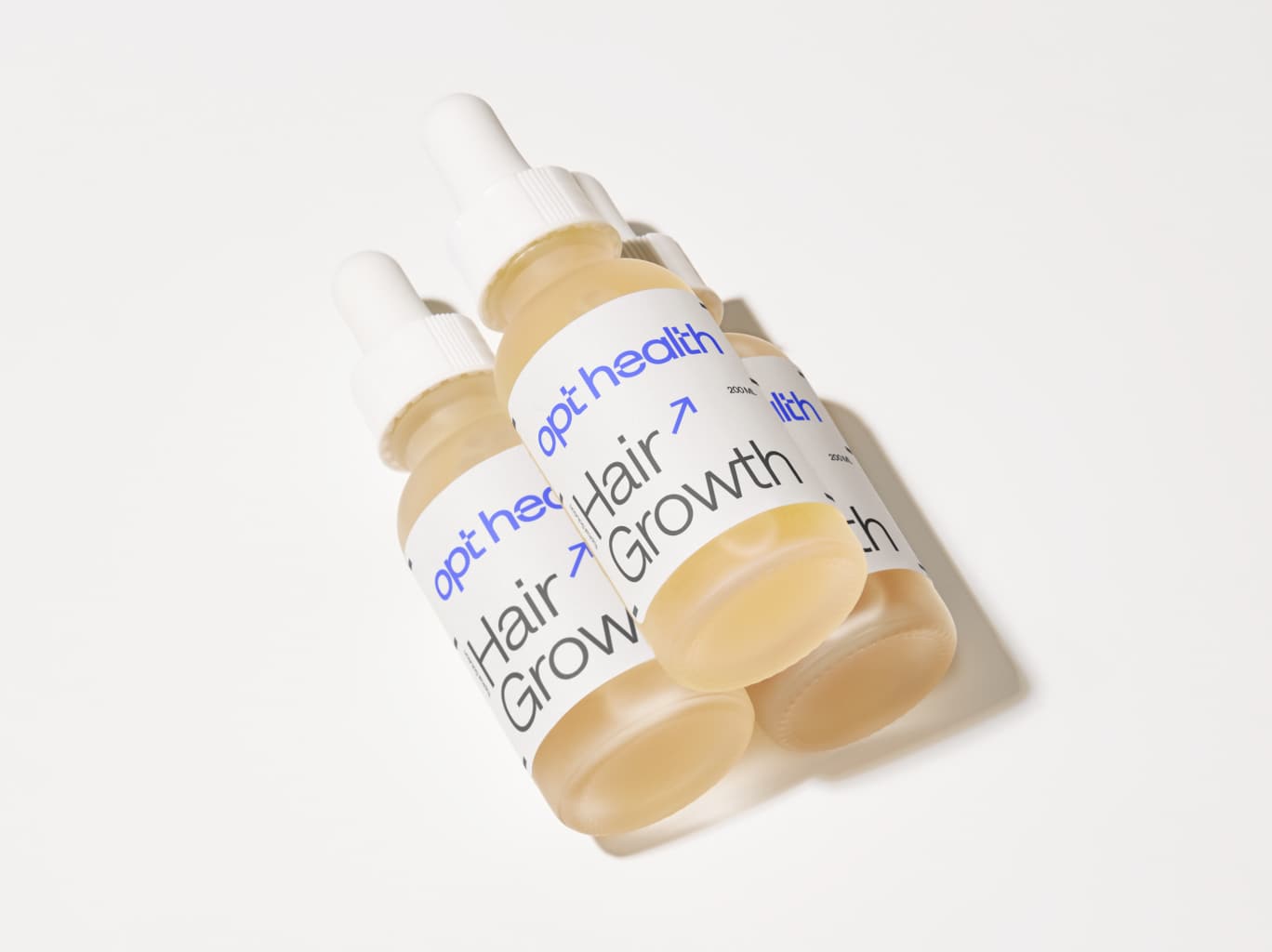
A potent formula of densifying active ingredients that promotes hair growth by blocking DHT, the hormone responsible for androgenic alopecia.
Minoxidil and melatonin extend the growth phase of the hair cycle.
Nourishing ingredients like vitamin E, caffeine, and menthol create an ideal environment for hair growth.
Ascorbic acid, panthenol, and sodium hyaluronate decrease hair shedding.
A potent formula of densifying active ingredients that promotes hair growth by blocking DHT, the hormone responsible for androgenic alopecia.
Minoxidil and melatonin extend the growth phase of the hair cycle.
Nourishing ingredients like vitamin E, caffeine, and menthol create an ideal environment for hair growth.
Ascorbic acid, panthenol, and sodium hyaluronate decrease hair shedding.
No results found
We are sorry, we could not found what you’re looking for. Try again later or try with a different keyword.
Clear Search





Our vitality doctors specialize in longevity medicine and men’s health. We help with lots of issues, including ED, low testosterone, and insulin resistance.
FAQ’s
Published clinical evidence indicates that combining oral finasteride with 5% topical minoxidil delivers the strongest outcomes for androgenetic alopecia driven by follicle DHT sensitivity. In randomized trials, oral finasteride produced clinically significant increases in scalp hair count over one to two years, while topical minoxidil 5% remains the most effective FDA-approved topical monotherapy. Research demonstrates this combination outperforms either drug alone: a meta-analysis found greater improvements in hair density and diameter, and a study of 502 men recorded that 92.4% stabilized or improved at 12 months, with 57.4% showing visible regrowth. Individual results vary, and a physician consultation determines the appropriate medical protocol based on your specific health profile.
Prescription hair loss treatments are generally safe when managed under clinical supervision, but suitability depends on the individual and the specific therapy chosen. DHT blockers target the hormone sensitivity behind male pattern baldness to slow or reduce further hair loss, though they do not eliminate thinning entirely. Because prescription options carry potential side effects, these therapies are not appropriate for everyone. A physician-guided protocol ensures your medical background is evaluated before starting treatment so your care plan is monitored safely over time.
Androgenic alopecia is the most common cause of hair loss in men, and family history is a well-established risk factor for developing it. The condition is driven by an inherited sensitivity to dihydrotestosterone (DHT) at the hair follicle. Medical treatments such as DHT blockers target that sensitivity directly to slow or reduce further hair loss. While these therapies do not act as a complete cure, consistent treatment protects vulnerable follicles from ongoing DHT exposure and helps preserve existing hair.
Topical minoxidil is an FDA-approved, evidence-backed option you can apply to the scalp at home without a prescription in its standard strength. Popular home remedies, oils, and supplements have limited and unproven evidence for androgenetic alopecia compared with established therapies like minoxidil and finasteride. Because genetic hair thinning responds best to approaches that address follicle sensitivity to DHT directly, a physician consultation helps you determine whether an at-home over-the-counter regimen meets your goals or if your plan should include targeted medical treatment.
Opt Health operates on a self-pay membership model and does not bill insurance directly, though members can use HSA or FSA funds toward their care. Commercial insurance coverage varies by plan, but standard policies rarely cover hair loss treatments that insurers categorize as cosmetic. Opt Health does not operate a dedicated gender-affirming hair loss program, though our medical care includes both men’s protocols and a dedicated women’s track addressing hormone-related health. Our physician-reviewed intake evaluates each patient’s hormone profile and medical history before prescribing, ensuring any protocol aligns with their specific clinical needs.
FDA-approved prescribing information for finasteride documents sexual side effects in a small percentage of men during clinical trials, specifically decreased libido, erectile dysfunction, and ejaculation-related changes. Post-marketing reports and FDA label updates also describe these symptoms persisting in some men after stopping the medication, which is why clinicians address the risk directly rather than minimizing it. Finasteride blocks the 5-alpha-reductase enzyme that converts testosterone into dihydrotestosterone (DHT) at the hair follicle, without lowering circulating testosterone levels or increasing cancer risk at the 1 mg dose. On fertility, finasteride can reduce semen volume in a small percentage of users, an effect that is generally reversible after discontinuing treatment. An Opt Health physician reviews this profile with you before prescribing and addresses any new or changing symptoms immediately during your ongoing care.
Androgenetic alopecia is driven by an inherited, ongoing sensitivity to dihydrotestosterone (DHT) at the hair follicle, which is why current medical treatments manage the condition rather than cure it outright. Both finasteride and minoxidil require continued use to maintain their effects, because stopping either medication allows follicle DHT sensitivity or the underlying growth-cycle issue to resume its natural course. When starting minoxidil, a temporary increase in shedding during the first several weeks to a couple of months is a documented part of how the medication resets the growth cycle, and it is not a sign of treatment failure. Consistent, ongoing treatment protects vulnerable follicles from continuous DHT exposure and helps preserve existing hair.
Significant or rapid weight loss acts as a physical stressor to the body that can trigger telogen effluvium, a temporary form of diffuse hair shedding. This pattern is documented after bariatric surgery as well as during weight loss achieved with GLP-1 medications, which are covered on the weight loss program page. Telogen effluvium is distinct from androgenetic alopecia and does not generally respond to DHT-blocking treatments the way pattern hair loss does. The condition is temporary and generally self-limiting as the body adjusts to the physical stress of weight loss.
FDA-approved hair loss medications, including topical minoxidil and oral finasteride, are labeled and approved for adult use. Hair loss in a teenager is less common than adult-onset androgenetic alopecia and more often points to an underlying issue, such as a thyroid condition or iron deficiency, that requires a different medical workup. Any treatment decision for a minor requires evaluation by a pediatrician or adolescent medicine specialist. Parents should address these concerns directly with the teenager’s pediatrician or primary care physician rather than through an adult telehealth hair protocol.